
The classroom is a distracting place! Staying engaged while silent reading can be challenging for even the best readers. Here’s a strategy to help students recognize when they’ve lost focus and help them repair comprehension––the think mark.

What is a Think Mark?
A think mark is a simple tracking tool that can help students during independent reading. As they read, they tally the moments when they lose focus and the strategies they use to get back on track.
Using a think mark can help students recognize, “Oh, I’ve been reading for two pages, and I don’t remember anything I read!” or “I keep rereading this sentence and I still don’t get it.” This metacognitive thinking is just the first step in helping them improve their executive functioning.
Executive Functioning and Reading
As it turns out, executive functioning is a critical component of reading, especially as students progress through middle and high school. While reading, students must depend on a variety of skills and abilities, including
- goal setting,
- reading for meaning,
- thinking flexibly,
- organizing and prioritizing,
- memorizing important information, and
- self-monitoring comprehension.
These strategies become increasingly important as students move up the grades, stepping into texts that are increasingly more complex. Students who “develop an understanding of their unique strengths and weaknesses (metacognitive awareness) and use strategies, typically show increased effort and persistence, positive self-concept, and improved grades in school” (Meltzer and Greschler, 2018). A think mark can help students reflect on and describe the processes and strategies they use during independent reading to stay focused on the goal of reading and understanding.
How to Introduce the Think Mark
1. Introduce the think mark by modeling your own reading process.
Example: “Yesterday, I was reading my book and even though the house was quiet and there were no distractions I found that my mind kept wandering to thoughts about what I was going to fix for dinner. After reading a whole page of my book I realized that I had no idea what I had read.”
Getting distracted while reading is a common problem that even the best readers face. The trick is to first acknowledge that you are getting distracted and then follow up with one or more repair strategies. Once comprehension is repaired, you can get back to reading the text and put more attention toward blocking out distractions.
Explain to students: To help me become more focused as I read, I can use a think mark. The first step is to tally each time I
- get distracted,
- find my mind wandering,
- get confused, and/or
- lose my place.
Show an example of your completed think mark. Ask the students, “According to the tallies I made, what is my biggest challenge? How might I solve it?”
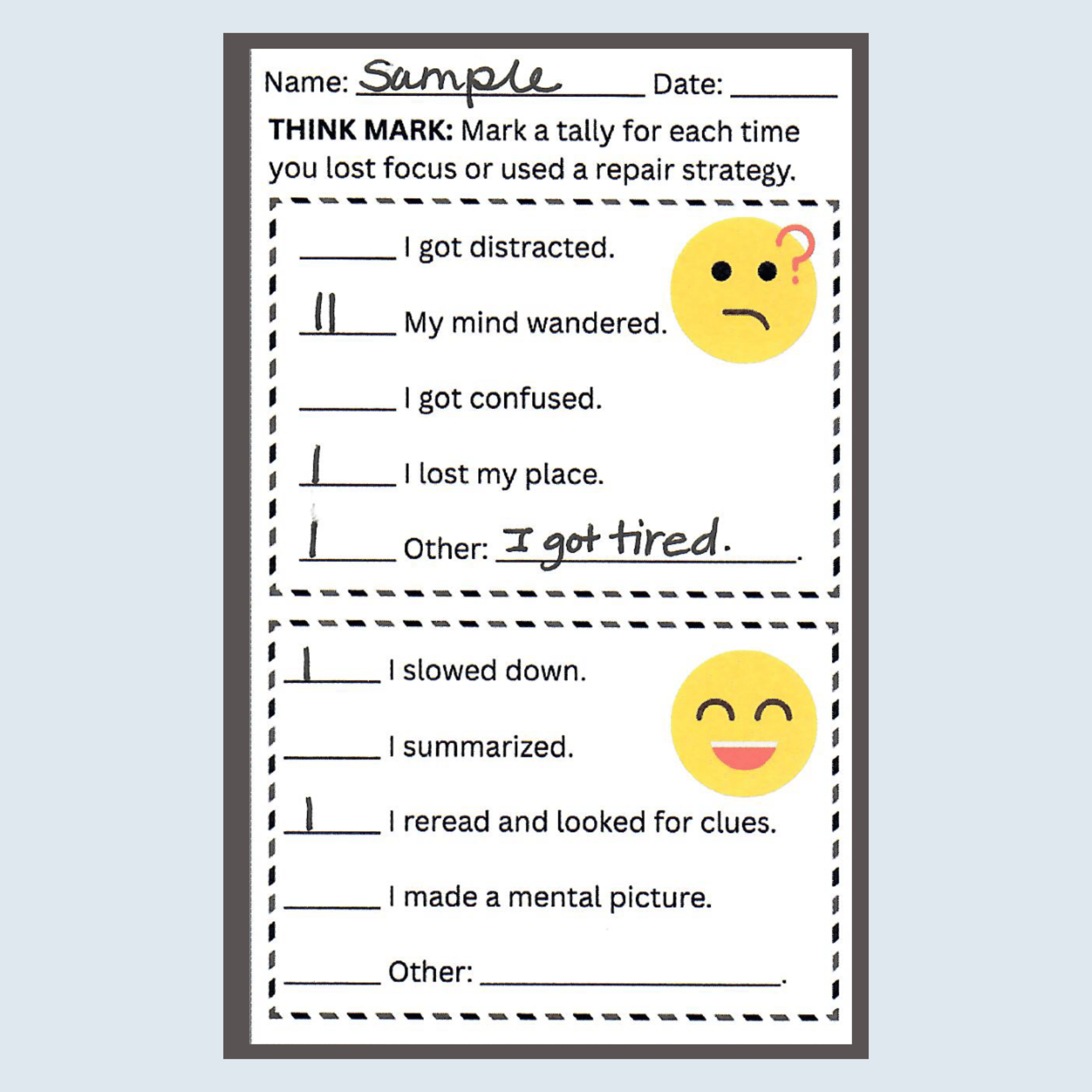
2. Teach students how to repair thinking.
Model the strategies in the chart below. Make this an anchor chart you hang on your classroom wall.
|
Fix-Up Strategies |
|
|
I got distracted. / My mind wandered. |
Where was I when I got distracted or my mind wandered?
|
|
I got confused. |
Where did I stop understanding?
|
|
I lost my place. |
What do I remember reading last?
|
3. Teach students to use the think mark to notice patterns and take ownership.
Explain how to use the think mark over several reading sessions to identify patterns. Encourage students to take ownership and build independence.
Examples of patterns:
- “I noticed I tend to lose focus after about ten minutes.”
- “I stay focused better when I am sitting in a quiet spot away from distractions.”
- “I get confused when there is a lot of dialogue.”
As students use the think mark in class, monitor progress.
What to watch for:
- Does the student have a lot of “I got confused” tallies but few repair attempts?
- Are distractions happening consistently under specific circumstances (sitting by a friend, sitting near the door, when reading nonfiction, etc.)?
- Does a student never mark confusion (possible overconfidence or lack of awareness)?
Provide feedback and guide next steps through one-on-one conferencing, task adjustments, and instructional mini-lessons as necessary. This way the think mark becomes a diagnostic tool, not just a behavior tracker.
Questions to ask during reading conferences:
- What patterns are you noticing?
- When do you tend to get confused?
- What repair strategy helps you the most?
- What goal do you want to set for next time?
Examples of goals:
- My goal is to have more repair tallies than distraction tallies.
- My goal is to summarize at the end of each chapter.
Final Tips for Using Think Marks
When you first introduce the think mark, the goal is for all students to practice and get comfortable using it. This is why I would require all students to use a think mark across a series of reading sessions. I suggest giving students a new think mark each day, marking the date at the top. Each day they will compare their results to previous days. This is how students will begin to identify their strengths and weaknesses and pinpoint which strategies work best for them.
After that, you might encourage students to use a think mark when:
- they start a new book,
- the content of the reading is heavy or less interesting, or
- they need help refocusing their attention.
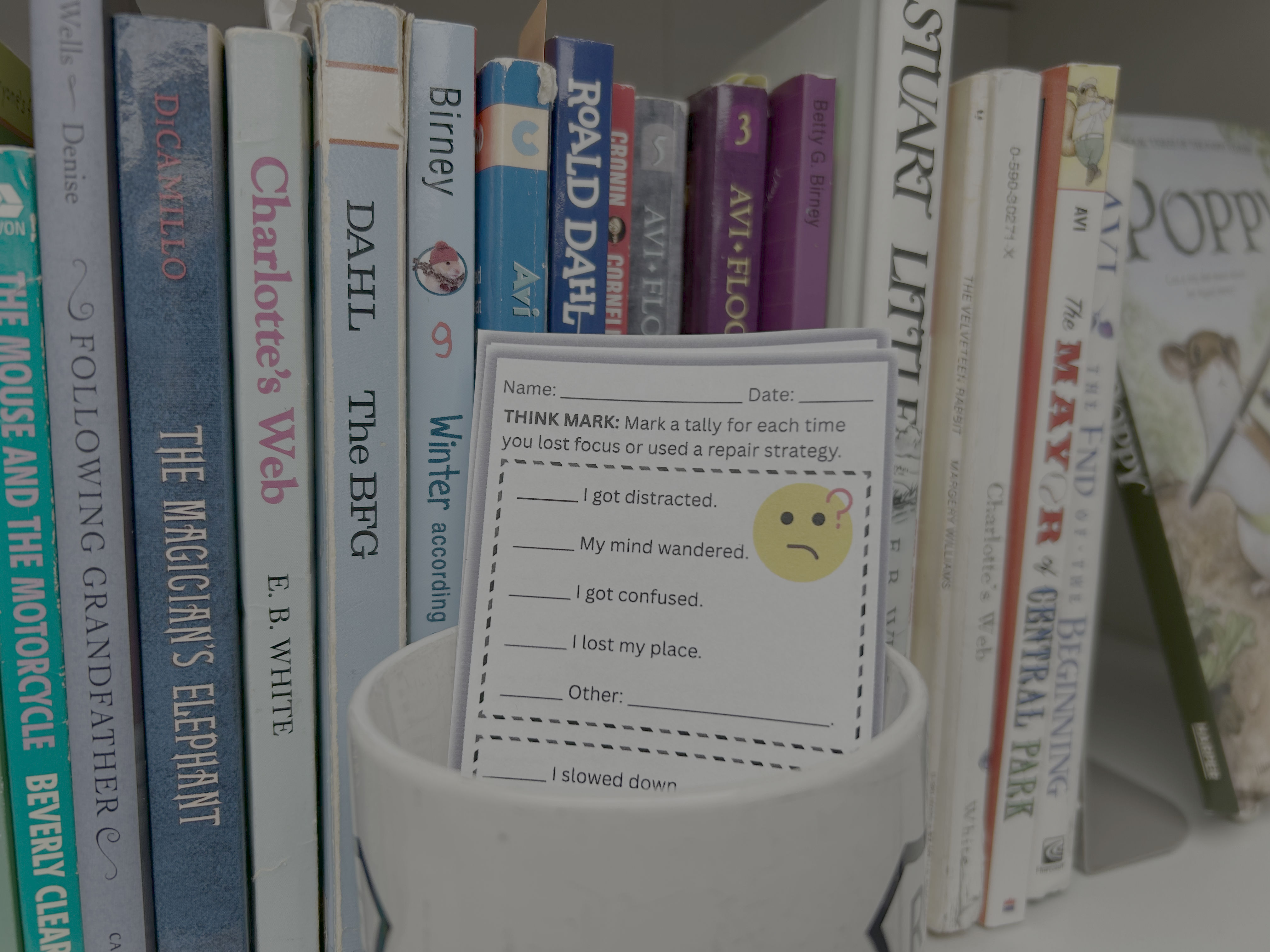
This picture shows think marks stored in a mug on the classroom library shelf for students to access during independent reading.
Make think marks available for students to access whenever they need them. Consider prepping a large quantity of think marks and choosing an easy location for students to access them during independent reading. Prompt students to “go get a think mark” when you see them struggling to stay focused and avoid distractions. Check in with them frequently to discuss goals and next steps.
Will you try this strategy in your classroom? Download and print our think mark or create your own!
Reference
Meltzer, L. & Greschler, M. (2018). Executive Functioning Strategies: The Building Blocks for Reading to Learn. The Examiner, 7(4), https://dyslexiaida.org/executive-function-strategies-the-building-blocks-for-reading-to-learn/.
Are you looking for a reading curriculum to increase motivation and success for middle-grade readers?
We are confident the Read Side by Side Reading Program will be the right fit for your next curriculum adoption! To learn more about the program and request a sample kit, connect with an advisor!

Written by Sarah Collinge
Founder & President
Read Side by Side Publications, LLC.
Sarah is the author of Raising the Standards through Chapter Books, 2nd Edition and the Read Side by Side Reading Program. Her work is impacting schools across the world that desire to increase students' confidence and motivation in reading. Her eleven years teaching intermediate students in Title 1 schools brings credibility to her work. Connect with Sarah!