What if one school day could change how a student sees themselves as a reader?
Read Across America Day is fast approaching! Many schools across the country will join the festivities by hosting guest readers and family literacy nights. If you are looking for something new for your classroom, we've got an idea that will spice things up: a book-in-a-day reading challenge!

What is a book-in-a-day challenge?
A book-in-a-day reading challenge is a simple and powerful way to increase students’ engagement, success, and confidence!
The idea of reading a book in a single day is not new. Mortimer J. Adler first introduced the concept in How to Read a Book (1940), emphasizing the importance of experiencing texts as complete works rather than fragmented pieces.
Reading a book in a day can be surprisingly powerful! The challenge not only helps students experience the whole of a text, it also
- deepens comprehension (students have fewer gaps in memory),
- builds reading stamina (readers learn to sustain their attention),
- builds reading confidence (readers experience a strong sense of accomplishment).
For many students, especially struggling or reluctant readers, finishing a book in one day can be a life-changing experience as they internalize a powerful message: I can read an entire book.
Here are four steps to get started!
1. Plan your event.
What day will you schedule your reading challenge? Readers can take this challenge anytime, but you may find it especially exciting near the end of the school year as a way to celebrate students’ reading growth and build excitement for summer reading.
Choose a day when you can protect about 180 minutes of reading time (yes, that takes planning, but it’s worth it!). You will be breaking the reading into manageable chunks to help students maintain stamina and focus. Plan to schedule four, forty-five-minute blocks of time. Don’t forget to incorporate breaks and movement between each block (your students will need it)!
Sample schedule:
- Session 1: 45-minutes
- Break
- Session 2: 45-minutes
- Lunch & Recess
- Session 3: 45-minutes
- Break
- Session 4: 45-minutes
- Celebration
The goal of this challenge is simple: sustained reading, comprehension, and the joy of the finish! This will require students to carefully select a book to read, with the guidance and support of the teacher.
2. Help students choose their book.
Well before the event, help students select the book they plan to read. Book selection is the most important scaffold in this challenge; the better the book choice, the more likely students will be successful (and we want all your students to be successful!).
Guide students to choose a book that:
- has a manageable page count,
- matches their comprehension ability, and
- is of high-interest.
| Grade | Page Count Recommendations |
| 3rd Grade | ≤ 100 pages |
| 4th Grade | ≤ 120 pages |
| 5th Grade | ≤ 150 pages |
| 6th Grade | ≤ 170 pages |
| 7th/8th Grade | ≤ 200 pages |
Students should consider reading a book they are already familiar with:
- the next book in a favorite series,
- a book by an author they already know, or
- a favorite book to reread.
Rereading a favorite book that students have read themselves or that an adult has read to them can deepen comprehension and increase reading fluency. This can be a powerful scaffold for students who need more support.
| Series Books ≤ 150 Pages | Page Count |
| Marvin Redpost | 75 |
| Moongobble and Me | 80 |
| Jake Drake | 95 |
| David Mortimer Baxter | 95 |
| Miami Jackson | 95 |
| Julian's World | 95 |
| Zach and Zoe Mysteries | 95 |
| Magic Tree House | 95 |
| Who Was? | 112 |
| Can You Survive? | 112 |
| Interactive History | 112 |
| Magic Treehouse Fact Finder | 128 |
| Bunnicula | 128 |
| Boxcar Children | 128 |
| My Teacher is an Alien | 128 |
| Wayside School | 128 |
| I Survived | 150 |
| Shiloh | 150 |
| Vet Volunteers | 150 |
| Ranger in Time | 150 |
Before starting the challenge, students should present their reading choice to the teacher for approval or to be redirected to a more appropriate title.
3. Use the CIA approach to structure each session.
Before reading, students should divide the book into quadrants.
- Divide the number of pages in the book by four.
- Put sticky notes in the book to mark the end of each quadrant (adjusting if needed to reach the end of the chapter).
- Aim to read one quadrant of the text in each 45-minute session.
As students read, they can complete the four-quadrant book report for fiction or nonfiction.
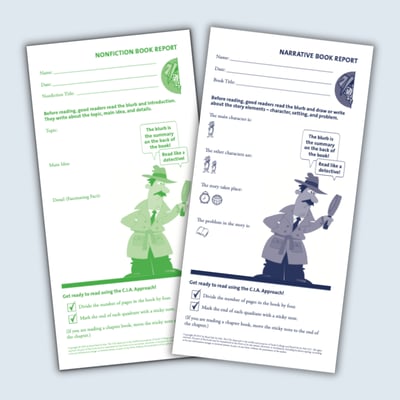
Session 1 (Quadrant 1): Collect critical information as you read the first quadrant. Pay attention to the characters, setting, problem, and important events. Retell the first quadrant to a partner.
Session 2 (Quadrant 2): Interpret the text as you read the second quadrant. Pay attention to the main character and infer character traits. What do you think the author is trying to tell you?
Session 3 (Quadrant 3): Interpret the text as you read the third quadrant. Pay attention to the author’s central message and gather evidence to support it. What is the turning point? How does it reveal the author’s central message?
Session 4 (Quadrant 4): Apply the text to your life as you finish the book. Do you agree or disagree with the author’s central message? Did you like the book? Would you consider reading another book by this author?
(Learn more about the CIA approach.)
4. Celebrate the finish!
There is nothing quite like the intrinsic reward that is felt when the reader finishes a book and it is this reward that will carry students into life-long reading. Don’t miss the opportunity to celebrate the joy of the finish!
As students finish their book, you might plan to reward students with a treat, trinket, and/or certificate. For many of your students, this will be the first time they have accomplished such an exciting task!
When everyone has finished their book, give students an opportunity to share their book with others. Plan for each student to:
- give a book talk,
- write a book review,
- create a poster, or
- participate in another culminating activity.
Sharing favorite books with one another increases reading interest and builds an excitement for reading that will continue to reap rewards! Don’t miss out on the opportunity for students to share their favorite books with one another after reading.
Are you up for the challenge?
I hope I have convinced you that a book-in-a-day challenge is not an impossible task and is well worth the effort to increase students’ reading motivation and confidence. If you are looking for a purposeful way to celebrate reading, on Dr. Seuss’s birthday or any other day, the book-in-a-day challenge is one I hope you’ll consider. Sometimes all it takes is one successful reading experience to change everything!
Purchase these items for your reading challenge:
- CIA Bookmarks,
- Fiction Book Reports / Nonfiction Book Reports,
- Download a Book-in-a-Day Challenge certificate of completion!
Are you looking for a reading curriculum to increase motivation and success for middle-grade readers?
We are confident the Read Side by Side Reading Program will be the right fit for your next curriculum adoption! To learn more about the program and request a sample kit, connect with an advisor!

Written by Sarah Collinge
Founder & President
Read Side by Side Publications, LLC.
Sarah is the author of Raising the Standards through Chapter Books, 2nd Edition and the Read Side by Side Reading Program. Her work is impacting schools across the world that desire to increase students' confidence and motivation in reading. Her eleven years teaching intermediate students in Title 1 schools brings credibility to her work. Connect with Sarah!